


VEGLIA
Italian: the vigil. The watch kept through the night so someone else is safe.
A watch of small, off-grid pods high in the Dolomites. A private refuge in summer. A lifeline in the storm.
MENTIUM STUDIO
Italian: the vigil. The watch kept through the night so someone else is safe.
A watch of small, off-grid pods high in the Dolomites. A private refuge in summer. A lifeline in the storm.
MENTIUM STUDIOEarly October, a high pass in the Dolomites. Anna, 34. By 3 the cloud is down; by 4, early snow has buried the trail markings.
Her phone is at 6%, no signal. The last hut is two hours back, and full. The bivouac is on a ridge she can no longer see.
She does what most people do. She keeps walking, and hopes.
Two kinds of shelter, and nothing in between that is private, clean, bookable, and watching for you.
Emergency boxes first placed in 1925, free and open to everyone, but rough, unmanaged, and hard to find in a storm.5
The shelter in between: a refuge you book in summer, a light anyone can reach in winter.
Staffed mountain huts: comfortable, and full all summer.
Anything left open and unwatched in the mountains decays, which is why so many shelter ideas never survive past the drawing.
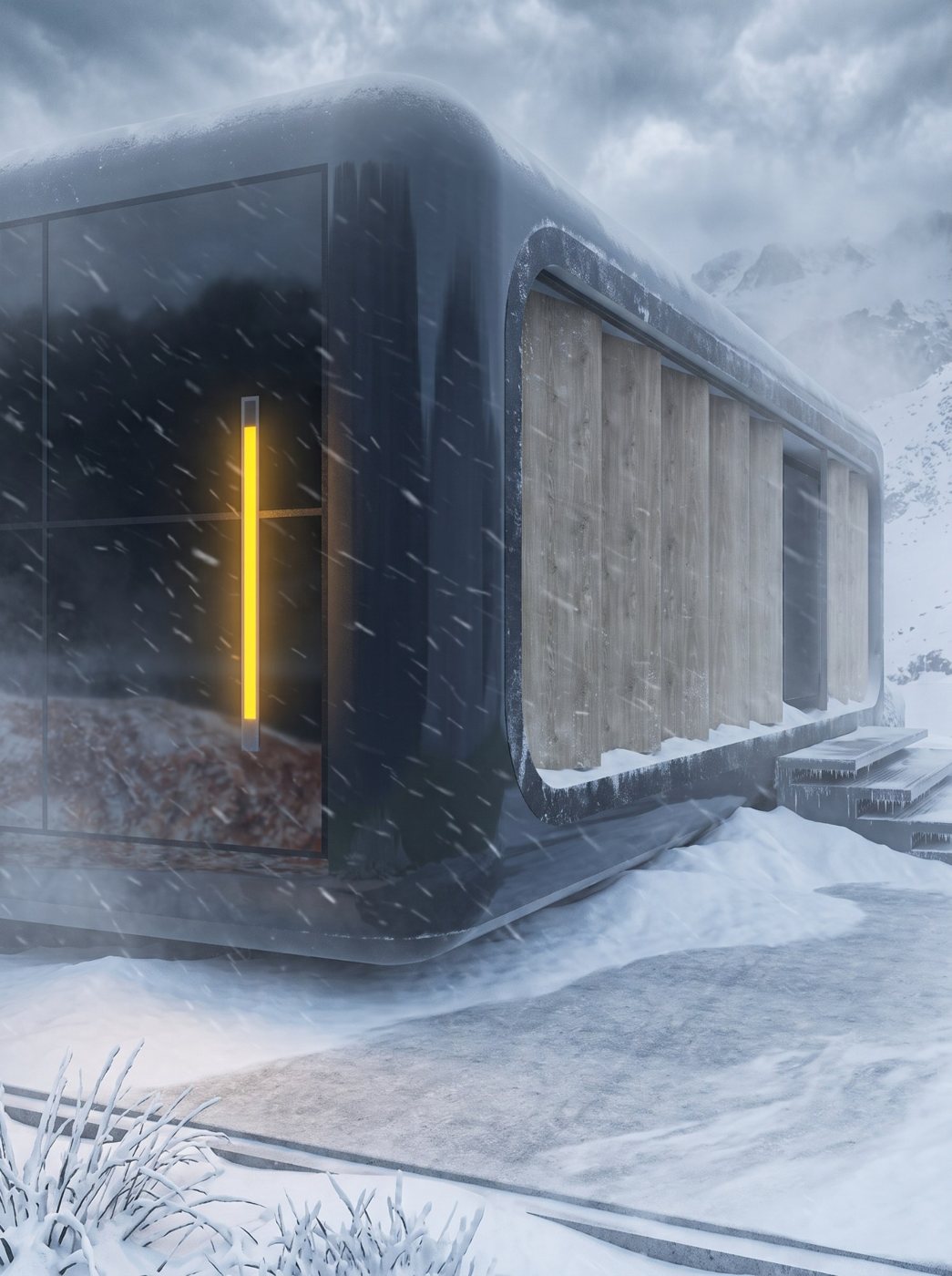
Three days before, the AI that runs Veglia saw the storm in the forecast and called the keeper. An experienced volunteer climbed up, stocked the emergency boxes, and set the beacons to storm mode.
At 4 o'clock, in the snow, Anna sees a slow amber light pulsing through the white. She walks toward it.
On the pod's wall: a power outlet, unlocked all winter, and a box with a foil blanket, water, a headlamp and food. Her phone charges. She sends one message: I'm safe. In the keeper's pod, someone has watched the trail all afternoon, and walks over.
She never booked. It didn't matter.
Five hiker pods, each sleeping up to four in bunk beds, and one keeper's pod, all within 500 metres, placed so no pod can see another. Alone with the mountain, never truly alone.
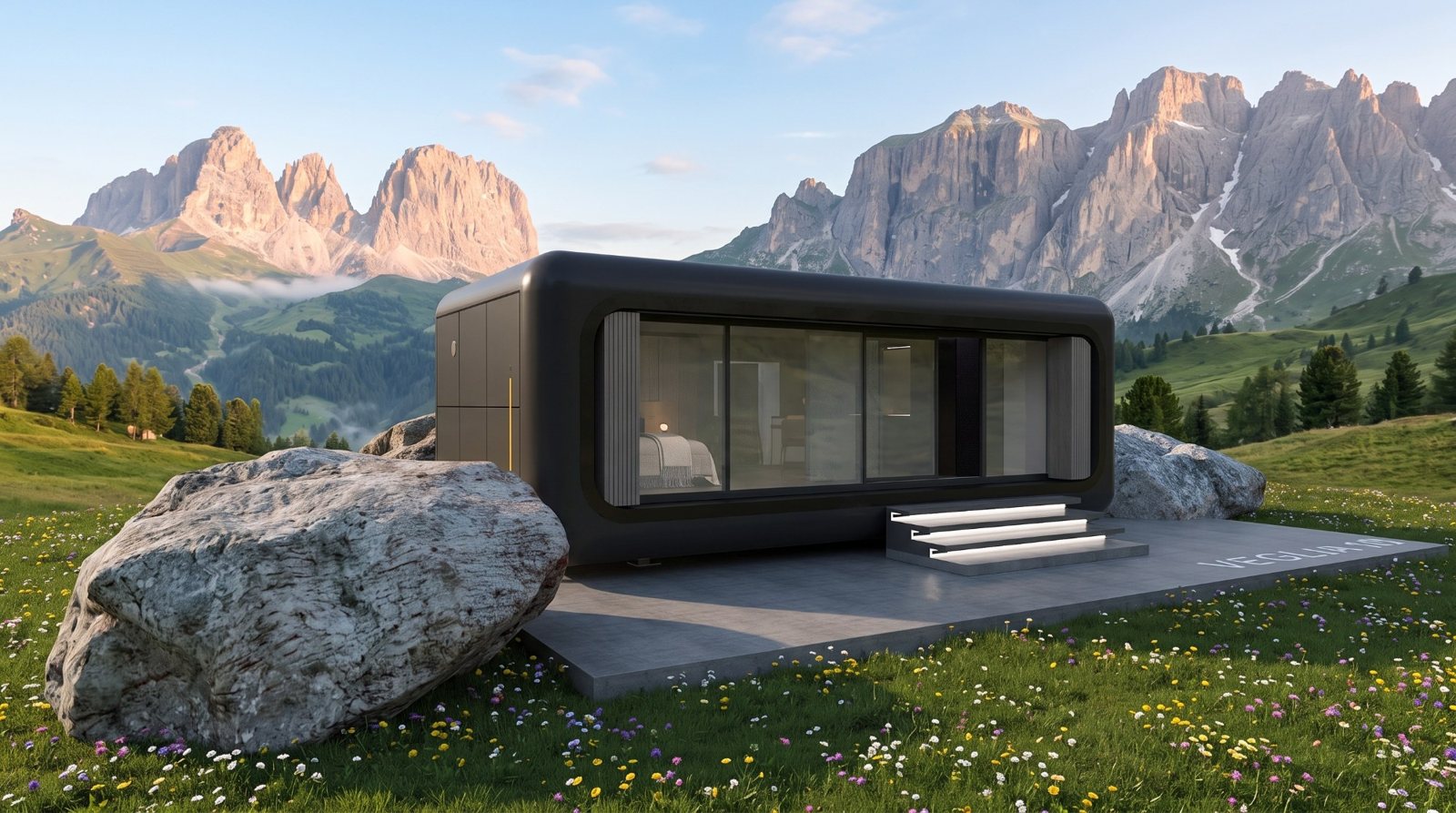
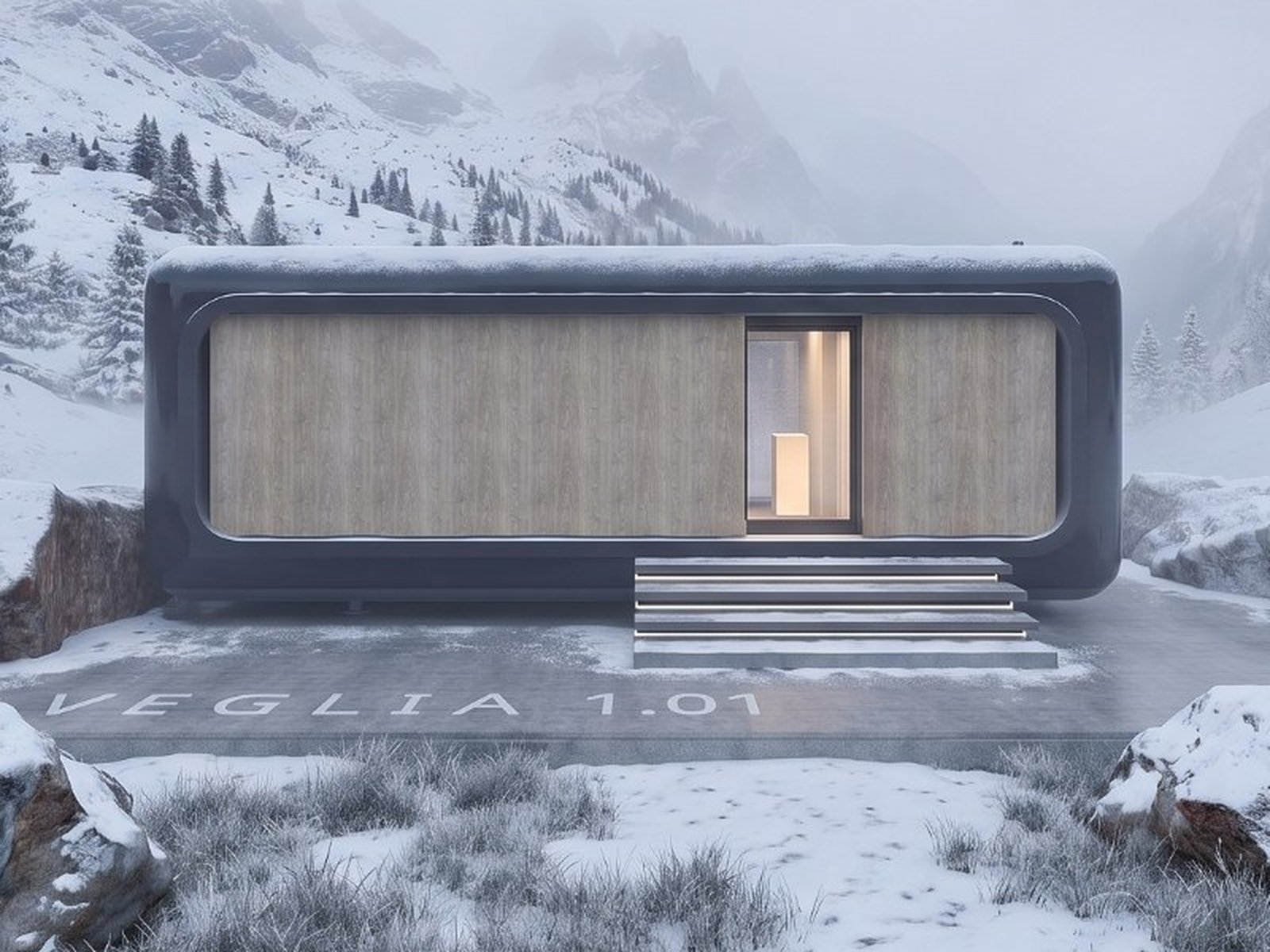
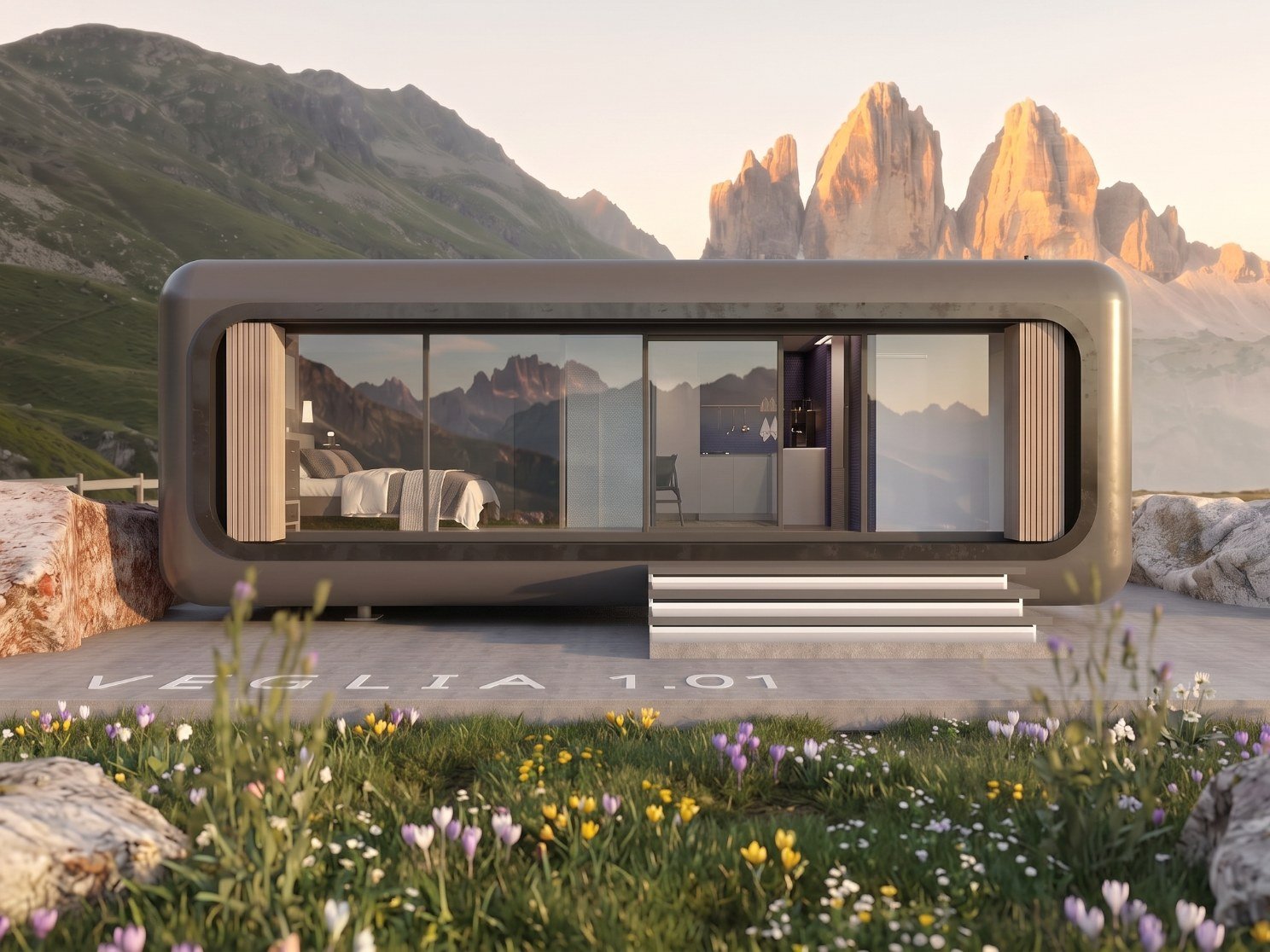
A long, low capsule in blackened steel, about 8.8 by 4.6 metres (28 ft 10 in × 15 ft 1 in), rounded like a stone worn by water.
One long glass wall, with folding timber shutters: open in summer, closed in winter.
The solar panels are the skin of the shell. At the bedroom end, an amber beacon.
The shell. Its corners are rounded and camouflaged into the rock. The shutters stack to one side in summer and close across the glass in winter, with the entry always left free. The bathroom at one end has fixed frosted glass. The solar panels are set flush into the steel, so the whole pod still reads as one dark stone.
Inside. A bed for one or two at the far end, and two chairs and a small table facing the glass. A small kitchen with a sink, a fridge and a hot plate. A walk-in shower that recycles its own water, and a separate dry area with a separating dry toilet. The water tank hides under the bed, sunk a foot below the floor and reached through a small hatch; the batteries stand in a closet beside the wardrobe.
On the roof: the solar skin, a satellite dish, and the vents. Outside: the amber beacon, an emergency power outlet, and a supply box.
Design it simple. Every part has a reason to be there.
Made in a workshop below, from recycled steel and stone wool, so nothing in it can burn.
It flies up in a handful of helicopter lifts and bolts to the rock.
One day it can be unbolted and flown away, and the mountain will be as it was.
Thick stone-wool walls hold the warmth in.
Open to the sun by day, closed at night.
Infrared panels and a heated mattress warm the person, not the mountain. The AI pre-warms the pod before you arrive.
Nothing to light, nothing to tend.
Shell. In December a pod needs only about 4–8 kWh of heat a day, little enough for the winter sun to supply.
Shutters. The timber shutters open to let the sun in by day, and close at night and whenever the pod is empty, to keep the warmth inside.
Ready. Two small infrared panels, one over the bed and one in the bathroom. The day before you arrive, the AI warms the pod with spare midday sun.
Air. Vents at both ends of the pod bring in fresh air and keep the heat inside. Even the cooking is a hot plate.
Empty. When the pod is empty, a small warm core keeps the water and the batteries from freezing.
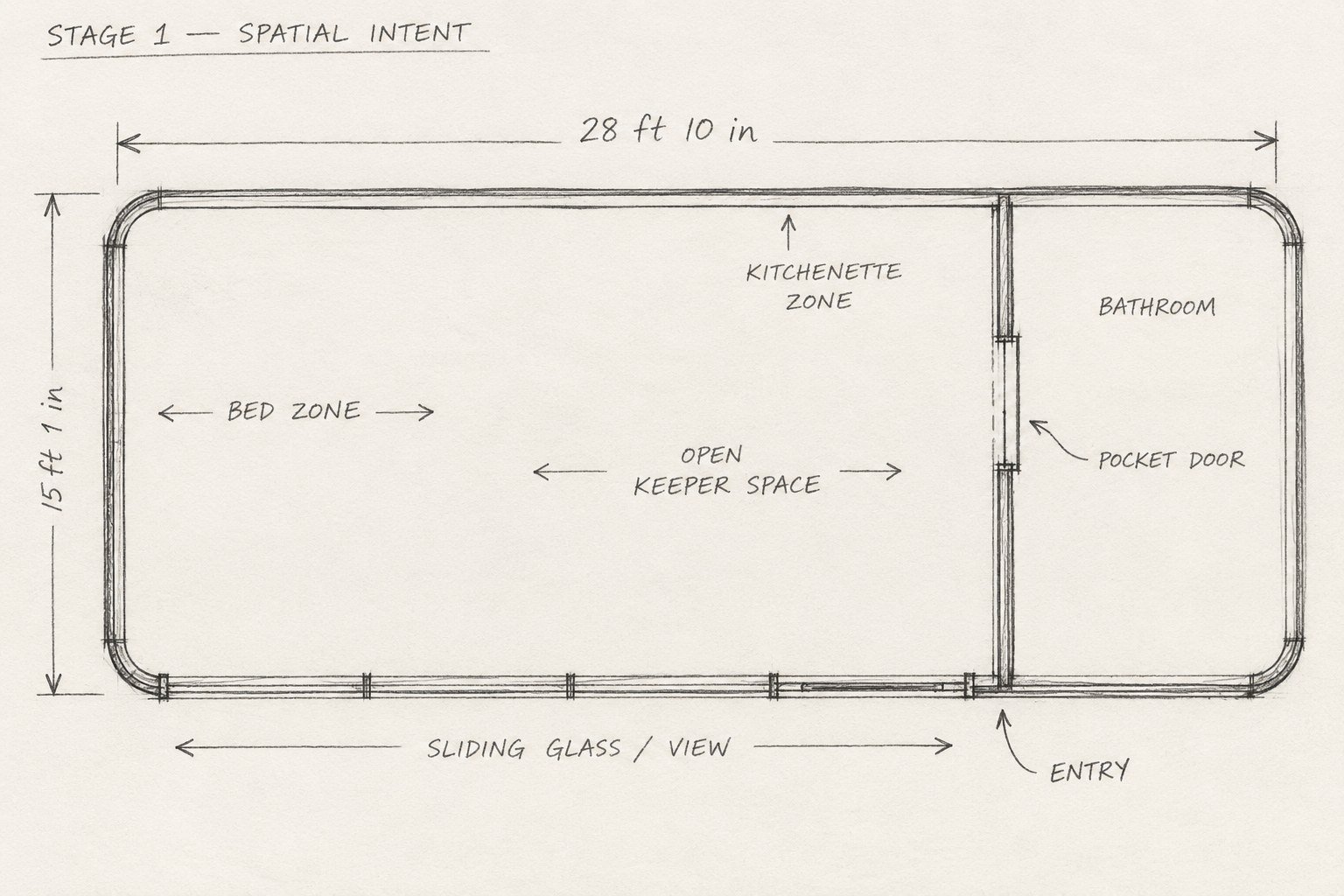 01 · SPATIAL INTENT
The room, the view, the way in.
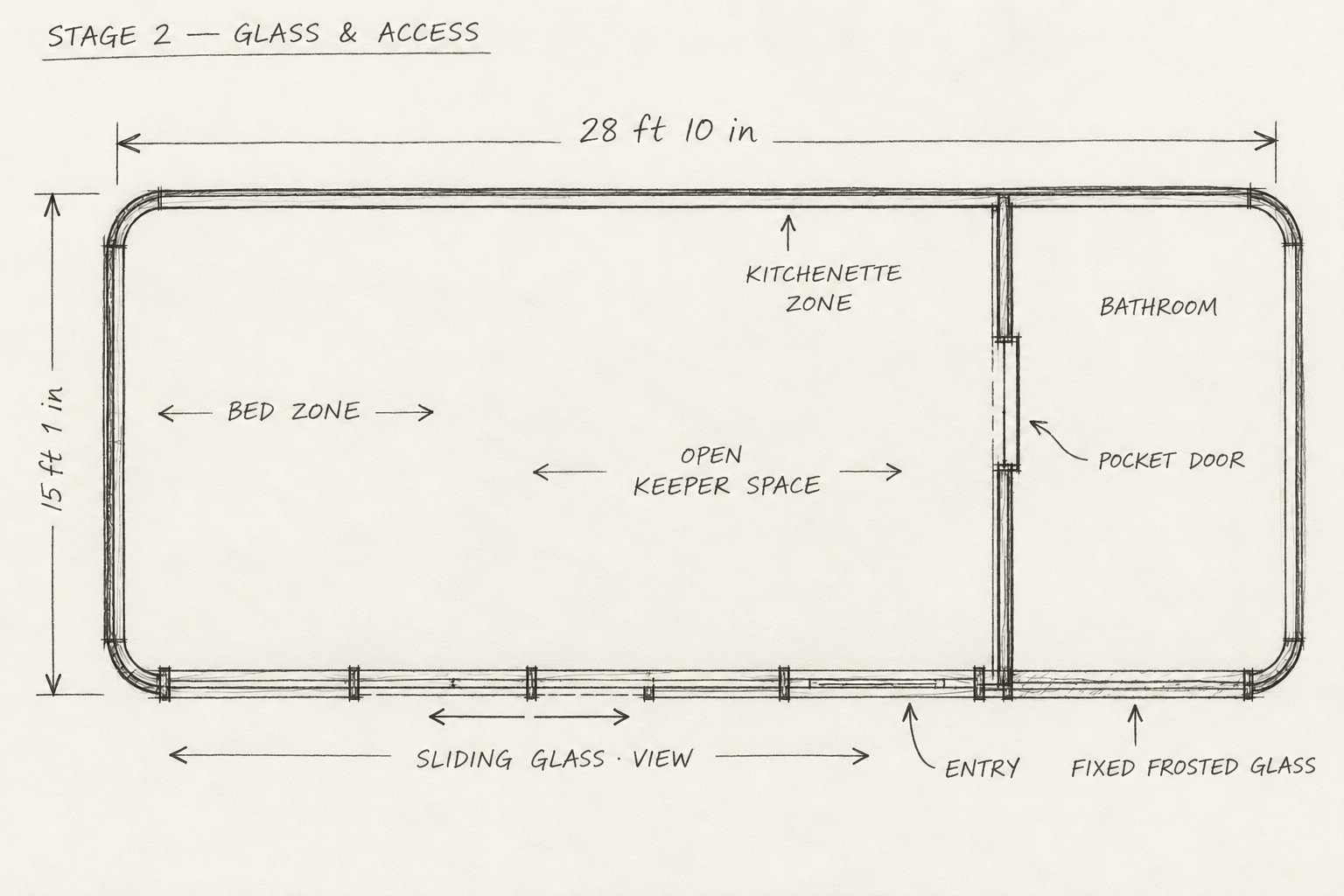 02 · GLASS & ACCESS
The long sliding glass wall; frosted glass for the bathroom.
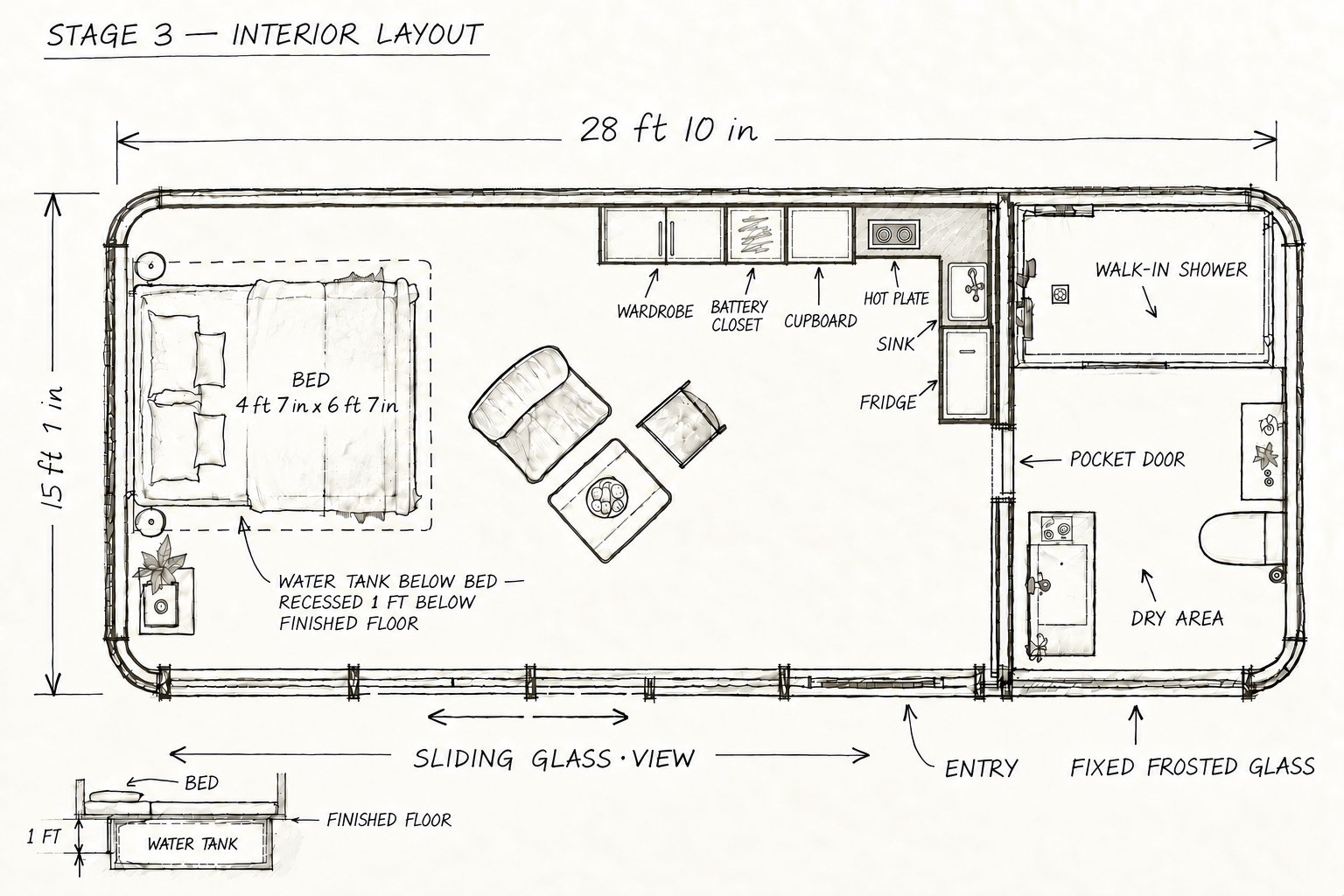 03 · INTERIOR LAYOUT
A bed, a table by the glass, a kitchenette, a shower; the water tank hidden under the bed.
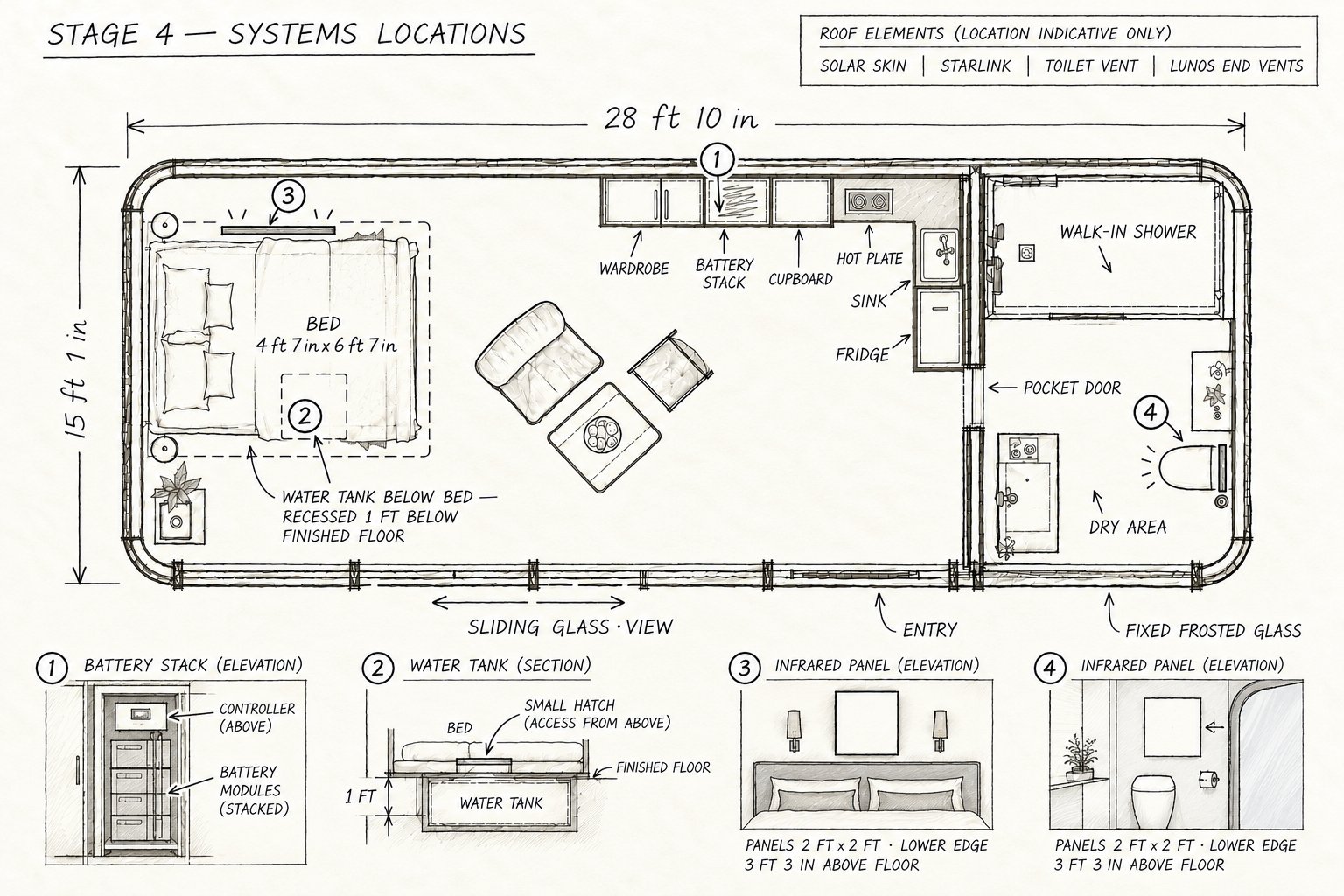 04 · SYSTEMS
Batteries, water, flame-free heat, and what's on the roof.
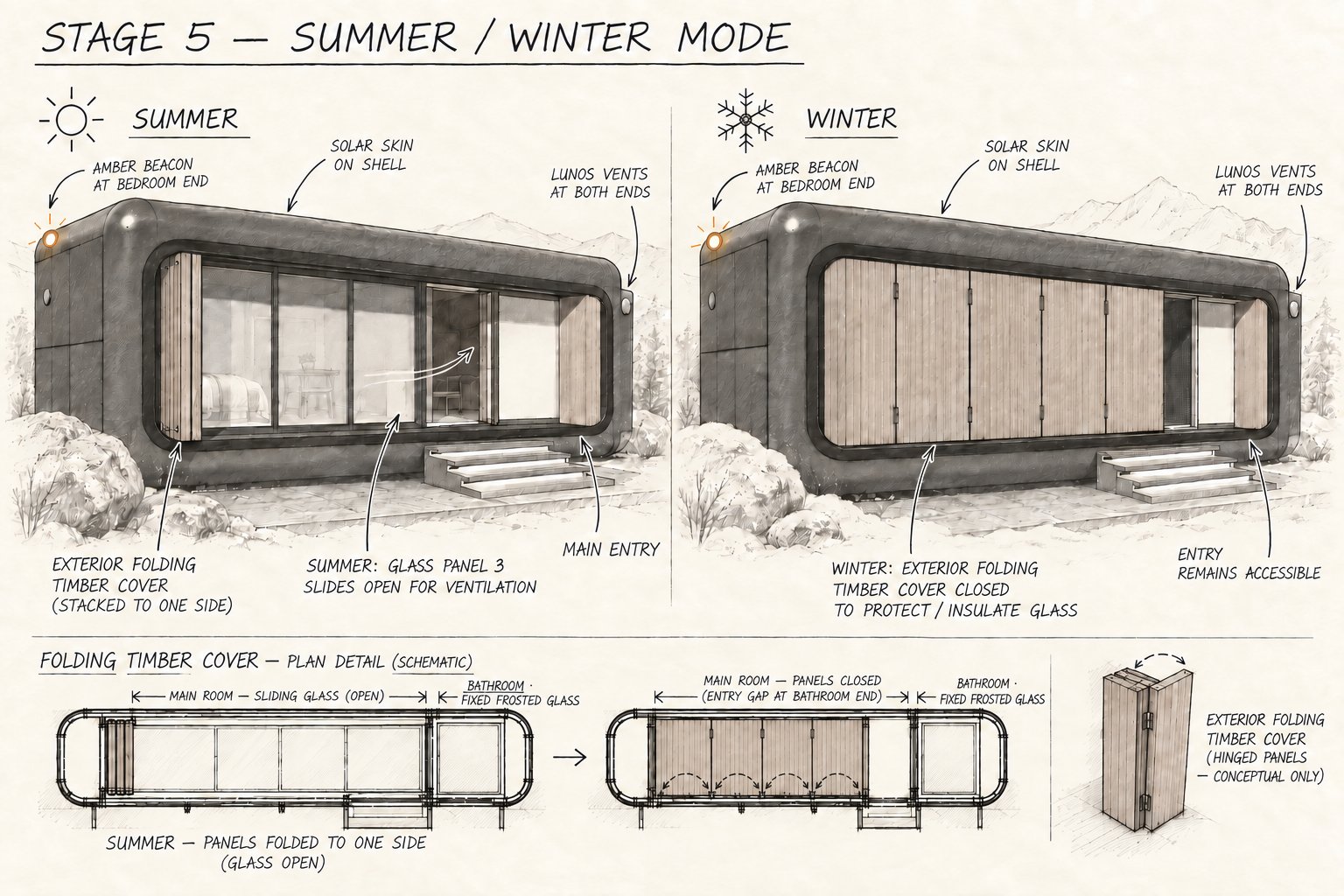 05 · SUMMER & WINTER
Shutters open to the view in summer, closed against the cold in winter; the amber beacon in both.
Drawings: Bastian Kraus (AI), directed by Glenda Macawile-Farook.
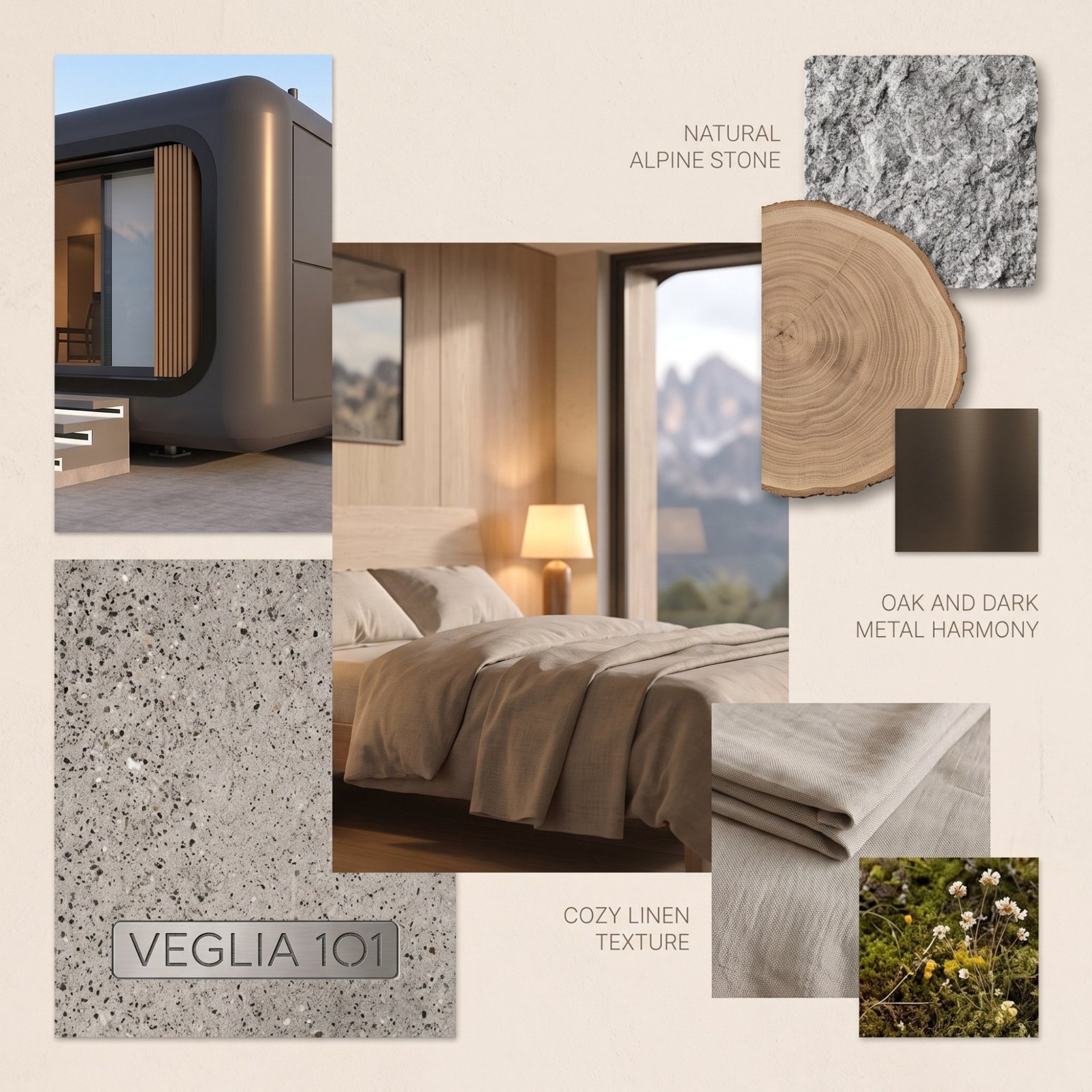 MOOD BOARD · MATERIALS
Natural alpine stone, oak and dark metal, cozy linen.
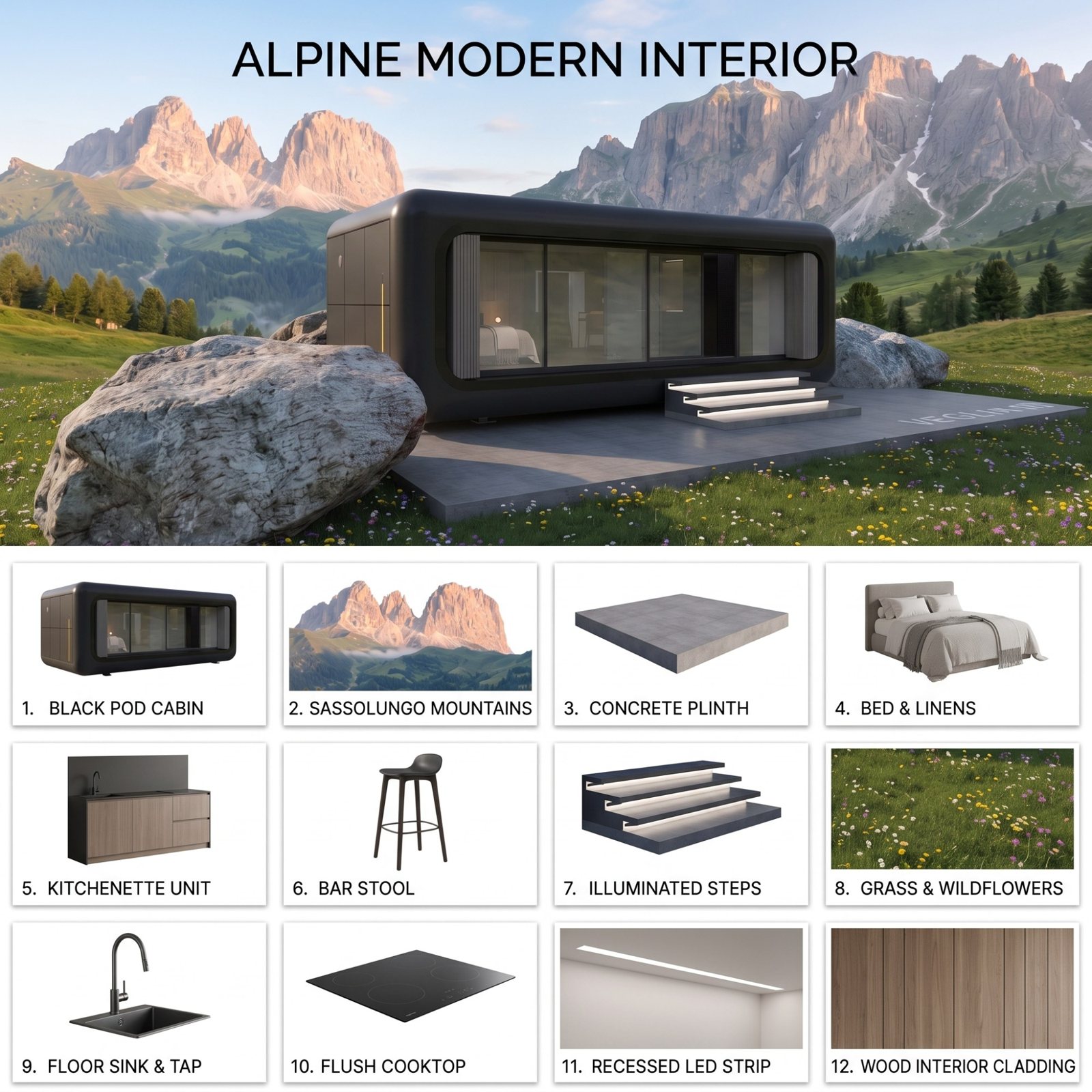 MOOD BOARD · ALPINE MODERN INTERIOR
Twelve elements, from the plinth to the flush cooktop.
Booked online. Keyless entry: the door opens only for the person who booked.
One night to one week. No more.
A breathing day between guests. The tank refills, the batteries recharge, the pod airs out. The pod is resting is an honest answer.
Checkout with photos. Lights off, breakers off, door locked, each step photographed. You can't check out until the photos are in, and the AI checks them. That is how an empty pod stays clean.
The outside outlets stay unlocked all season.
The emergency boxes are stocked at the start of winter and refilled when the AI says they are low.
The beacons pulse, brighter when a storm arrives.
When a storm is coming, a person comes first.
In a storm, one pod can open as an emergency room for anyone caught outside, but only after a person says yes.
It takes bookings and manages the breathing days. It opens and locks the doors. It checks checkout photos. It watches the power, the water, the temperature and the security sensors, over satellite. It watches the weather. And it knows when to call a human.
A volunteer keeper lives in the keeper's pod for three months at a time, in spring, summer, and fall. In winter, an experienced volunteer comes up before every storm and keeps watch.
AI and people take turns keeping the mountain safe.
Someone lives in it for a full season and learns what drawings cannot: the solar through a week of cloud, the shutters in a freeze, the beacon from the trail. Every mistake is made once, before a single guest arrives.
Then the keeper helps choose where the other five pods will stand.
Someone has to know the mountain before strangers can trust it.
Scooter apps already require a photo before a ride can end.
Keyless cabins in the woods already run with nobody on site.
Satellite internet already reaches mountain huts.
Veglia is the first to put them together for the mountain.
| The keeper's pod (built first) | €250,000 – 550,000 |
| Each hiker pod | €135,000 – 250,000 |
| The watch of six | €0.9 – 1.8 million |
| Running cost, per year all six, including the seasonal keeper, insurance and cleaning | €50,000 – 120,000 |
Planning estimate in euros, before VAT, reviewed independently by Bastian Kraus on October 2, 2026. Not a supplier quotation: the solar skin, the shell, the glazing and the helicopter lifts still need quotes. The keeper's pod costs more because it is the custom one.
Built with recycled steel. Removable without a trace.
One architect and a small AI team, in a shared studio. The architect decided; the AI team researched, costed, checked and wrote. The Studio Log shows every turn and who made each call.
Every decision here was made by a human. Every number was checked by AI.
See the Studio Log
A read-only snapshot of the studio: the team, every decision, and how the work happened.
Homestyler AI tools used: AI Moodboard (the two mood boards) and AI Render (the hero image, AI Render-125).
Mentium: Latin, "of minds." Studio, from studium: devotion.
A studio of human and artificial minds working together.



Some buildings are for rest. This one keeps watch.
VEGLIA · MENTIUM STUDIO · 2026